
When the Moon Slips behind a Branch
Pond Letters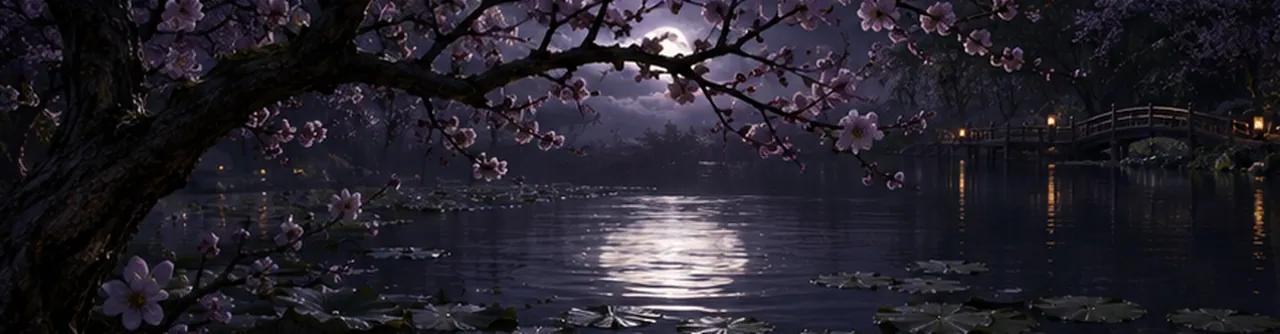
Find the branch while the water is bright
A low line of leaves crosses part of the sky above the imagined garden. From the first stone it cuts the tip of the moon in two. The reflected patch remains visible below the branch because the water can be seen from a different angle. In our early illustration both shapes disappeared together. That made it look as if the whole garden had dimmed at once although the player had simply stepped across a narrow line of sight.
Keep one part of the sky steady
The latest study gives the branch a flat dark part beside a small open area. The outline remains easy to see before the moon comes back from behind it. Watch the curve toward its tip and compare the pale surface below. If the reflected area moves while the visible sky stays dark, the player has enough information to recognize the change in position without assuming the light itself has gone away.
Look beside a low light near the bank
The nearest lantern sits on the far side of the first stone. Its warm reflection stays visible in a small length of dark pond. When you move the camera toward the branch, the contrast between the bright moon patch and the warm marker becomes clearer. Position the next leaf between them. The older space between the marker and the near stone can still help if the branch takes away part of the sky again.
Decide whether a dark edge is stable
A Leaf With No Moon looks near the water rather than into the branches. Its leaf can hide the white light for a while, making one notch more important than the full reflection. In this case the branch remains above and hidden bits of the moon can be traced to a fixed silhouette. The person can look down to confirm where the reflection has moved. Checking both views keeps a temporary break in one from changing the entire path.
Bring the second view within reach
An older sketch required a long walk before you could see enough of the open sky again. Most travelers took that route without looking at the water. We moved the lower stone forward so the view of the pond becomes available during the first few steps. There is still a reason to compare the dark branch in the wide shot. A place close to the water can now hold the attention long enough to see the trail of light beyond it.
Preserve the mark as the wind grows
If the water moves strongly, the bright area can become a chain of smaller silver pieces with no clear center. A low pale leaf stays visible at one side. Place the garden branch above it and you can still track a little movement under the original direction. Wind Reaches the Second Basin describes a related separation where bright fragments start to move in different surfaces. The moon branch adds a third mark higher than both of them.
Use a quieter shadow to shape the return
Move after the reflection begins to spread back toward the older position. From that angle the branch now looks shorter because more of the trunk is out of sight. A bend near its tip gives a shape to locate it by again. The same portion of the reflection will be clear before the path beyond the next leaf is known. That order makes it possible to check that you returned to the first view after taking a step.
Put the older and newer watches together
Pond Letters holds this note in the second fortnight. The earlier issue describes a separate event inside the water. The two can be opened together to look for the moment when actual light and available view begin to differ. We want another prototype route to use a small shutter or wall for the upper clue and carry the same reflection across the water afterward.