
A Leaf With No Moon
Return to Leaf Drawer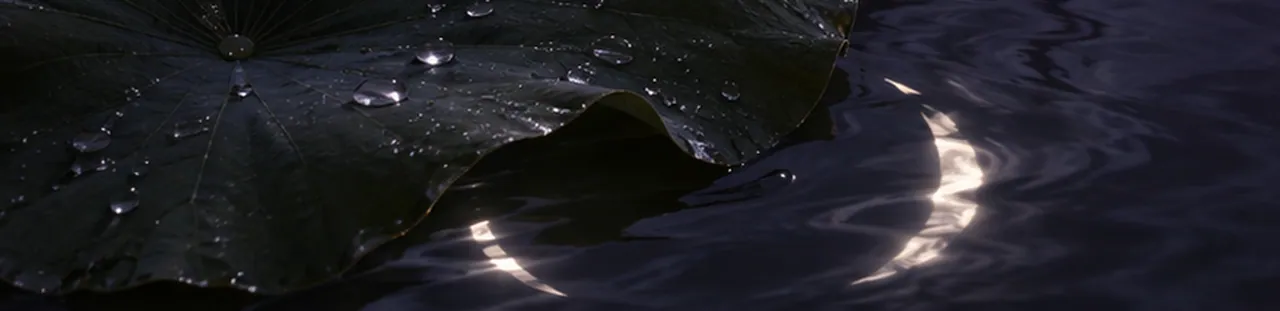
Start on a dry stone
The nearest stone reaches into the pond below a small lantern. From there the player can see three leaves with different edges. A bright area appears beside the biggest one for part of the view. When it floats a little farther across the water it cuts into the reflection and leaves a small curve in place. You have time to learn the curve before moving your view toward the next stone.
Look across a missing part of the water
At the first step a bright portion of the next leaf vanishes in the water. You can still see part of its outer edge, because a little reflected light remains behind it. Try to compare the gap it leaves with the gap between two neighboring leaves. A Leaf Interrupts the Light describes how we kept that relationship visible without outlining every leaf. Waiting at the stone gives another chance to compare both shapes during a smaller ripple.
Recognize a leaf in a different position
As you move a little lower, the far portion of the pond becomes hard to see. The dark leaf could appear much closer because it covers more of the reflection. Its notch points toward a small bright edge on the left. Choose a viewpoint where they appear together. The player can take the next step if the pale line leads to the known leaf and still shows a stable point on the side near the stone.
Preserve a reference in the garden
A low lantern on another side of the path gives a much warmer reflection than the moon. It stays close to the same edge when a leaf passes and offers a stable spot from which to compare the dark shapes. When the Moon Slips behind a Branch studies a related view where a nearer branch blocks the visible moon before the reflection leaves. That shift preserves just enough context to find a new direction.
Find an alternate return
You can move around the first stone to a place where another leaf appears in the tall reflection of a tree. The narrow shape begins at the same height as the leaf seen from the near side, but it moves in a different direction. Going back there after the first crossing gives the player another clear view of where the light disappeared. The route keeps a way back to the bank if the gap changes before the next step.
Draw dark surfaces with different edges
The pond is dark with pale silver above the water and a little rose color near the railing. A leaf should have a broad soft shape beside the moon and a rough vein where the lantern touches it. Small droplets may brighten at the top of a leaf but stay away from the main landmark. The person needs a thin surviving shape rather than a row of bright instructions floating above the water.
Prototype scope
The original concept currently explores a short walk across one part of the pond. It tests whether a person can read three edges before and after one large interruption. Leaf Drawer describes that sequence in order. A later scene may put the first usable leaf in shadow from the beginning, with a familiar notch appearing again after a ripple moves past the quieter side.