
Rings at the Quiet Edge
Pond Letters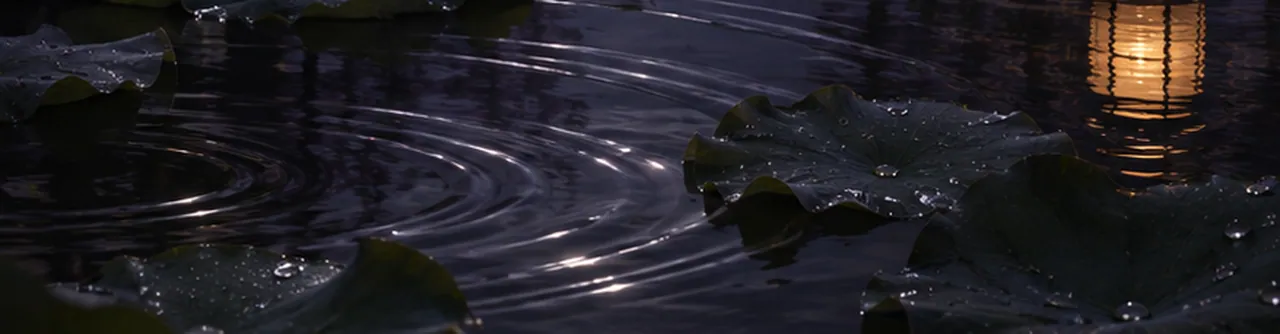
Look for the first clean circle
Near a low stone beside the bridge, a ring begins in open water. It moves past a leaf and touches the far edge of the narrower basin. There is a thin return from that edge a short time later. The first version of the scene showed several equally bright rings around the entire pond. It felt lively but did not give a clear time or position at which the person could decide to take the next step.
Give the ring a part of the pond to cross
We made the near section fairly still around three darker leaves. At the beginning of the disturbance, one bright curve becomes visible where the water starts to turn. Follow the curve until it slips under the nearer leaf. It reappears beyond it with a thinner edge. The space between the moving curve and the unchanging bank tells you that it has not reached the part of the stone where the next step will go.
Wait for the return near the rim
A narrow wave continues out of sight under the farther side. When the next piece of its arc becomes visible, it travels away from the rim rather than toward it. The traveler can see a short line move past a leaf from the opposite direction. The Second Surface uses a related choice to wait on a dry part of a wall until the farther side clears. The broad ring allows you to see a second useful change before leaving the original stone.
Keep a steady object behind the movement
At one end of the pond a small lantern casts a short amber reflection. It breaks into lines for a moment when the ring crosses it. The lantern itself stays visible above it, giving a clear place to return your eye when the whole rim looks dark. In addition to the warm patch, the low edge of the stone marks where the first motion reached the middle of the pool.
Use the leaf to separate a ring from a highlight
An earlier image featured a pale band on the wet edge of a large leaf. It crossed one of the rings exactly and seemed to keep moving around the pond after the ring had passed. A Leaf Interrupts the Light discusses how a small shape can survive after the bright reflection changes. In this scene the stronger line travels past the leaf and disappears. The pale wet part stays in place to make the distinction available.
Give the garden another kind of rhythm
The wide shot shows two groups of ripples. One begins farther away and moves slowly across the basin. The quiet edge responds more quickly after a small event near the stones. Keep their spacing different and leave some of the far water in view as the nearby ring crosses. A person can then tell why the two views feel out of step. The comparison does not require repeating a single timing pattern around the whole pond.
Find a place to pause between views
The lower path reaches a stone before the ripples go through the open area. Someone moving quickly might look up from it as the return passes. Let them step back and wait for part of the next ring without losing the place they found. The far reflection already helps place the near stone from the side. The shorter view will tell when to take another step after the water opens again.
Read the current issue with that pause in mind
Pond Letters keeps this study beside the one about the shadow from the branch. It gives another reason to keep a stable point on the rim after some of the reflection has changed. A later sequence can introduce a different quiet edge farther around the same basin. The person should still be able to describe where the returning ripple began, at least in relation to a leaf and the last solid thing they saw.